********************************************************************************************************************
This message may contain confidential information. If you are not the intended recipient please inform the
sender that you have received the message in error before deleting it.
Please do not disclose, copy or distribute information in this e-mail or take any action in reliance on its contents:
to do so is strictly prohibited and may be unlawful.
Thank you for your co-operation.
NHSmail is the secure email and directory service available for all NHS staff in England and Scotland
NHSmail is approved for exchanging patient data and other sensitive information with NHSmail and GSI recipients
NHSmail provides an email address for your career in the NHS and can be accessed anywhere
For more information and to find out how you can switch, visit www.connectingforhealth.nhs.uk/nhsmail
********************************************************************************************************************
Friday, 16 July 2010

Monday, 22 September 2008
Beehives and Keynotes
Once you get through the sales pitch to the shareholders and wall street analysts we get to the meat of this mornings key note - the announcement of Oracle Beehive a new updated version of Collaboration Suite. Oracle demonstrated the product to me while I worked at DFID back in 2004.
All in all it looks a great product, it is based upon open standards it should be possible to link it in to existing infrastructure. I'll try and find out more about the product of the next few days - in particular what is different between Beehive and the old Collaboration suite.
Web 2.0 and Oracle
One of the uncomfortable truths for Oracle is that the Web 2.0 world runs on MYSQL.
There a undoubted problems with this but when Digg, Yahoo and Google use the LAMP stack to build and deploy large scale performant applications which require no direct licence payment - idea for cash limited startups.
As programs such as Twitter becomes moneytisied by being deployed into companies as collaboration tools, they will come with MYSQL - not Oracle. This could be a major threat as DBA become use to supporting MYSQL and the bottom line costs become significantly cheaper, CIO & CTO become more aware of use of OS solutions.
DICOM support in Oracle 11g - Case study Novartis.
It takes 15 years to develop new drugs. Companies want to improve the critical path. From the compound selection to its final certification for clinical use.
The use of imaging is becoming more critical to show success of new drugs as they show the effects of the trial drugs quicker than traditional physical diagnostics.
Hospitals become part of the trail and are contracted as 3rd parties. They take modiality scans of patients during the trial and send scans back to the drug company for study management.
The key challenges the companies have when trying to manage the trails evidence using medical images include:
- No single RIS / PACS are hospital centric, no workflow quality management solution
- Data Access and Control
- No easy access to data for follow up after initial work
- Scattered environment , prop images
- Data transfer
- No single standards, no audit trail, patient confidentially ,
- data
Novartis upgraded to 11g in 2008
Images are directed as an object in the DB. Its no longer a blob. Data does not need to be parses, so file infrastructure is not needed. The DB manages the archive as part its data life cycle.
Future a requirements is for the support of a flexible DICOM dictionary - managed through the database metadata service.
The development of a data quality rules through a XML schema. This would include image level rules, content of images, audit. This can then be brought
Sunday, 4 May 2008
Bread
Did anyone know that Bread can be made at home in a Machine! The last I heard to make bread you combined the floor, water and yeast then beat the hell out the dough, let it swell and then cook.
Well since yesterday we now have machine in the kitchen, awaiting the first deposit of ingredients. We had false start yesterday when I confirmed that I'd picked up the skimmed milk - I failed to hear the question was 'powdered milk'.
Still I've popped out this morning (still managing to avoiding looking at the front of newspapers) and purchased the powdered milk so I'm now expectingly awaiting my first slice of machine generated bread.
Saturday, 3 May 2008
Meet to new boss same as the old boss
Well London has spoken, and Comrade Ken has lost his first election. I've never been a 100% committed Kenster, epically as he went against a promise not to stand in 2000 against the Labour Party, if he wasn't the official candidate.
So lets hope Boris doesn't throw the baby out with the bath water and try and put a right wing stamp upon London, but somehow something tells me everything has everything is about to change.
Monday, 28 April 2008
Inlaws Siege Update
When coming back from darkest Kent on Sunday I got a gargled message saying my Mother in Law had been evacuated by armed police due to my Father in law running amok. This is what happens when you rely upon a 10 year talking a phone message and allowing the wife to get the completely wrong end of the stick when he passes the message on and she can't make contact with her parents. Now I know Tom's home brew is a bit on the wild side but I couldn't quite believe that Tom would snap and then start waving a sword around at his age.
In actual fact both of my in laws had been asked to stay at their sisters home while a mini armed siege developed in a house a few doors down. Anyway full(er) details can be seen here: Armed excitement in Carlton in Lindrick.
Twitter...hum
For the last few weeks I've been using twitter to update my Facebook status. For those who don't know what twitter is asks the simple questions: what are you doing? then allowing you only 140 characters to reply! The ui is simple, a text box and an update button.
Twitter has been described as Micro blogging using the discipline of the small message size found in SMS combined with the user interactivity of IM. What's clever is that twitter allows you to follow other users (or twitters) feeds. This creates a dynamic community of short posts, with the twitters you follow updating their feeds in almost real time. You can pose questions to your followers and post directly to other users.
A community of sites has built up as an eco system of complentary sites. Twitter hasn't yet really taken of on this side of the Atlantic compared to the US, where some of the Web 2.0 hero's can claim upwards of 20000 followers. I currently have 10 followers and follow 20 or so. I've struggled to convince friends to take it up but I'm sure in a few months it will be the 'site de jour'.
One of the challenges with technologies such as Twitter is the ability to build an application that unexpectedly capture the moment and have to scale to massive volumes. Twitter uses the LAMP technology stack so the db layer is MYSQL which is being see very heavy db writes to support the application. I'm not sure that currently MSSQL has the answers for providing this sort of scalability and responsiveness. Oracle has Times Ten (in memory single process space) or Coherence (multi process scalability). Although some users have 20000 followers the big challenge will be when a major celeb like a Paris Hilton starts using Twitter and draws in hundred's of thousands of followers.
Kevin Rose said that Digg.com was built originally to support 100k hits per month - currently they have had to scale the web site to manage 25 million unique hits per month. That means that all the original code has been replaced, at the same time limiting the length of time the site is unavailable as the upgrades are slipped in. Infrastructure technologies such as 'grid' and services such as Amazon S3 mean that Web 2.0 start ups do not need put all their startup capital into datacentres and infrastructure, but the underlying architecture and software design still has to take this into account. One of the major reasons for the failure of .com fashion retailer Boo.com, was the need to procure and build an infrastructure that had to support hugely optimistic visitor and sales numbers predicted in the initial business case from day one, yet were starting their business from scratch with much lower numbers visitor numbers.
If Twitter allowed controlled or limited access communities (like Facebook's networks functionality) the technology could be great in the workplace, but as its currently configured it is not possible to publish sensitive questions to colleagues only which is a major drawback.
My twitter page can be accessed by following the link. Please create an account and join the fun.
Sunday, 27 April 2008
End of Season
Blackheath rugby season came to an end on Saturday, as and usual the end of season festivities went on long into the warm spring evening.
The yesterdays opponents were Manchester, in what, for them, was a must win game in order to guarantee them promotion to National one. For Blackheath the season has drifted since Xmas as our own promotion push faltered. In all truth although our forwards held there own our backs came up short both in defense and attack. Still we have ended the season in 5 place and not had to worry about relegation this year.
After the game, a bbq was rolled out and the beer followed long into the evening. A number of kicking competitions took place on the field while the first team auctioned off their playing shirts. I managed to get my hands our retiring hooker shirt. Lexi had almost 200 caps for the club so I will proudly wear his shirt home and away next year.
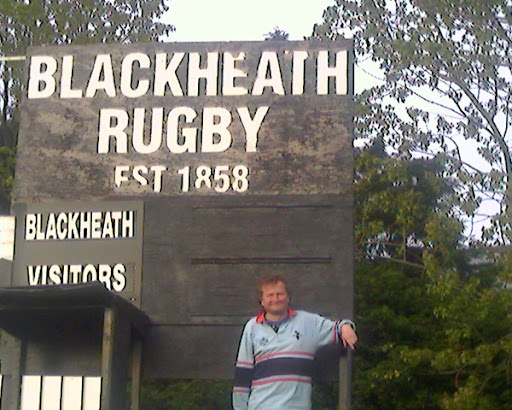
Barmy Mark managed a life long ambition of running the score board - however this wasn't till after the game had finished.
Today I'm of the Kent cup final in Cranbrook
Friday, 25 April 2008
Royal Geographic Society
The Sun event took place at the RGS squeezed between Hyde park and Imperial College. Although the outside facade is of a post modern 60's building, once you pass through reception its clearly a Victorian building.
On the wall hang maps original created by English and Dutch cartographers in the 17th Century. In the map room large portraits of Livingstone, Stanley, Cook and Scott adorn the walls.
The lecture hall, had wonderful leather seats with each one marked by a name which I assumed to be name of its associated member.
I'll see if the society is open to the public and suggest that we take the boys for nose round.
MySQL - Sun take over...
After a hiatus I'm back. I promise to make more effort to keep the blog up to date.
This morning I've been at on the 11 world wide events Sun is running to understand the future of MYSQL since Sun competed its acquisition in February.
At least of the healthcare software suppliers is using MYSQL to store documents.
I'm also starting to use the LAMP stack for a website I'm developing at the moment. The database is MYSQL so
Simon Phipps - SUN Open Source envangalist Simon Phipps is the first speaker will it be the cathedral pitch. Of interest is that Simon is English and is a
Simon quoted Gartner who are predicting that within 5 years 90% of commercial software will be based on or be completely opensource. Not sure about this - within the the UK health care market I'm not seeing the suppliers moving in that direction. (That is not say that tech's such apache / java are being shunned by suppliers). The software being built and deployed is not based upon a OS licence.
I've heard Simon talk before and this morning talk wasn't his most convincing - I'm not buying that end of the procurement model, to be replaced by the subscription model.
Richard Mason is next up - he's an salesman who came from MYSQL, with a background in RDBMS. He going to explain why Sun brought MYSQL.
first up - complementary product lines - Sun gets access in new markets such as SME. MYSQL was a 400 man company so Sun will provide the business infrastructure to grow.
Sun putting one billion dollars into LAMP, which Sun believe is into its existing products lines such as Java and Glassfish.
Sun will continue to run MYSQL as - the product will remain open, multi platform to all market segments. A
New subscription offering 'MYSQL Enterprise' is the moneytised support offer.
David Axmark is next up, he was one of the founders of MYSQL. It as side project back in the 1996 as side project. He thought it might pay their salaries but he never expected it be sold for a billion dollars.
After reflection it looks like at least in the short term not a lot is going to change. Will Sun make a play the large scale enterprise space currently the home of DB2, Oracle and SQL Server?
Subscribe to:
Posts (Atom)